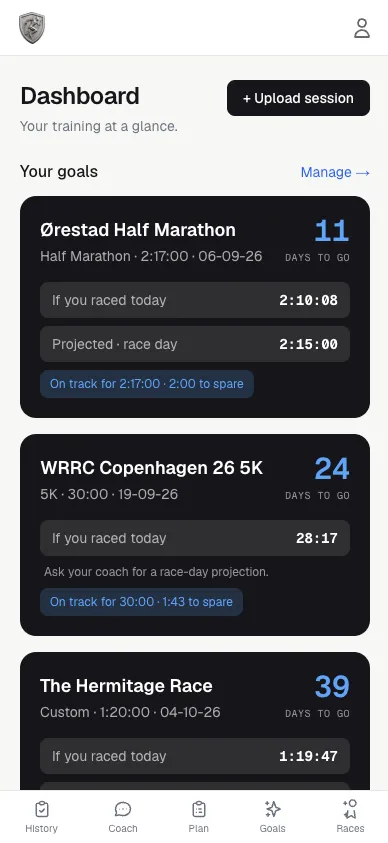
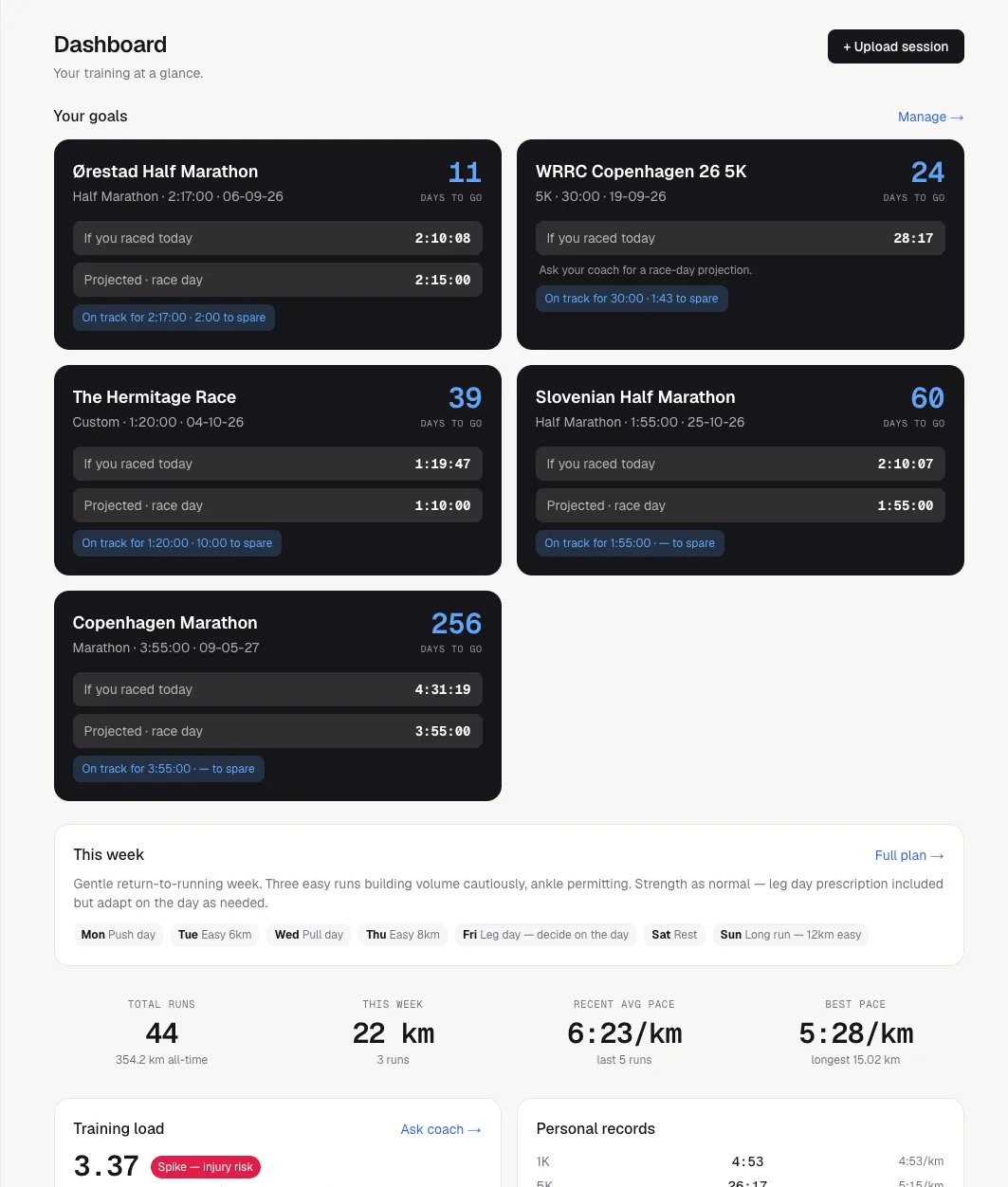
Overview
Gunna is a training log with an opinion. It ingests workouts from Apple Watch and Garmin, computes the metrics that matter for distance running, and puts an AI coach on top that sees your goal, your full history and your recovery data, so the feedback after each run is grounded in your training, not generic advice. It covers strength training too: gym sessions are parsed, merged with watch data and factored into the weekly plan.
It is built for exactly one runner: me. Training for a half marathon while lifting twice a week, on a phone, on the couch, ten minutes after finishing a session.
Role
Solo. Product decisions, data model, parsers, coach and UI.
Scope
Ingest, metrics, plan and coach. One athlete, running and strength together.
Constraints
Serverless, no workers, no ops budget. Must survive a free model provider retiring a model overnight.
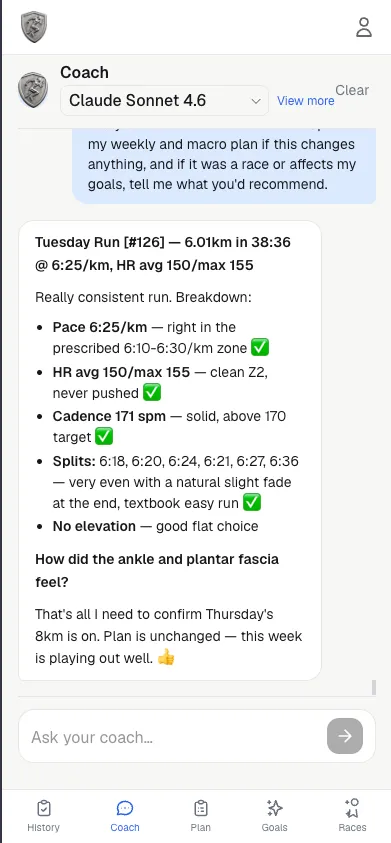
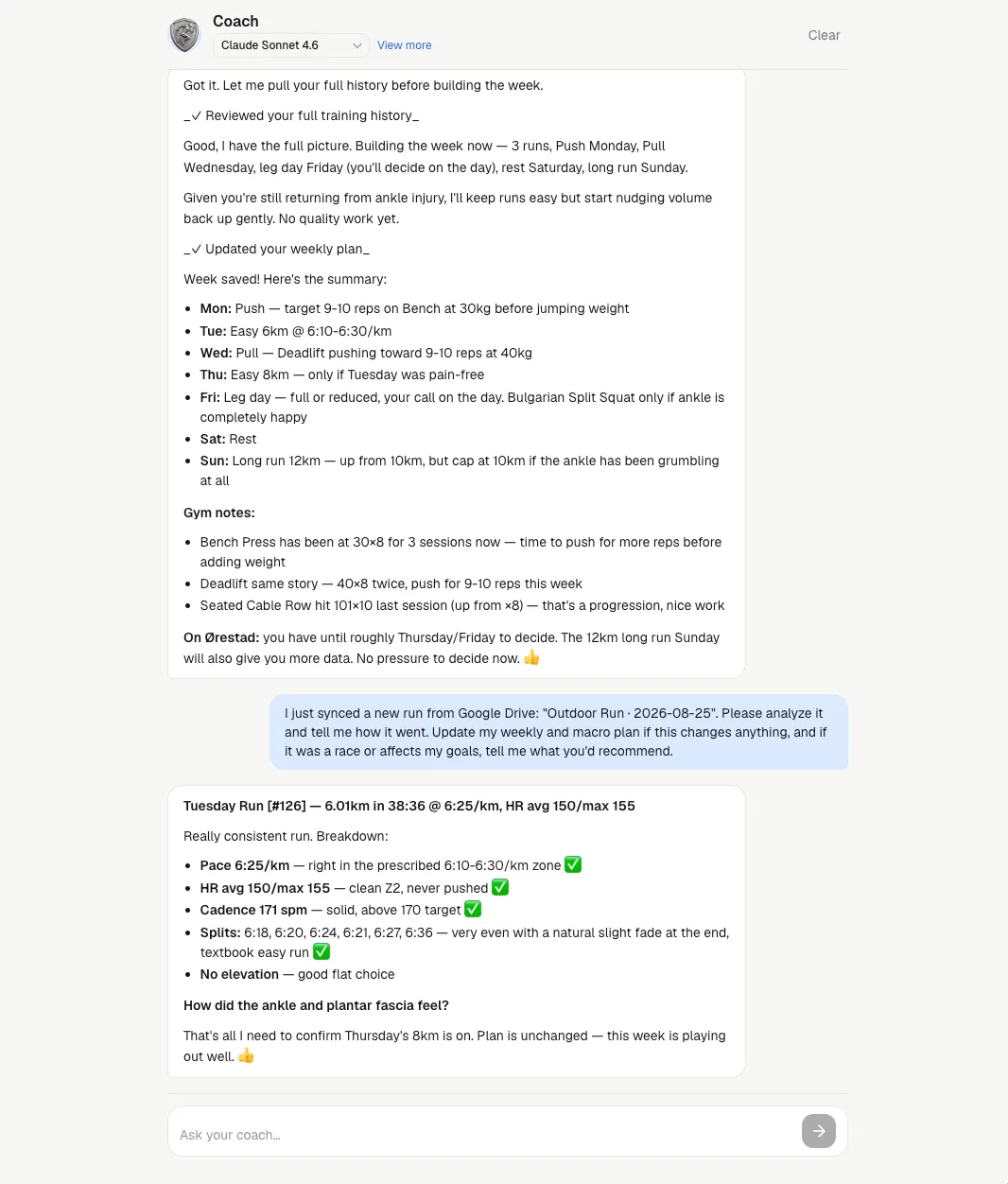
Every imported run opens with this. The coach has already read the splits, the heart-rate zones and last night’s sleep before it says anything.
That reply is the whole product. Everything below is what it took to make a few sentences worth trusting.
The problem
Running apps show you charts; they don’t coach. And the data you’d coach from is scattered, the run lives in HealthFit or Garmin, the lifting session in Strong, recovery metrics in Apple Health. Three apps, none of which know the other two exist, so the one thing nobody can see is the whole week.
I wanted one place where all of it lands automatically, and one coach that reasons over the whole picture and can actually change the plan.
One training picture
Six ingest paths, all converging on a single parser core. Whichever way a session arrives, it lands in the same shape.
File upload
.fit · .tcx · CSV
Google Drive
HealthFit auto-import
Garmin Connect
activity archives
Garmin bulk CSV
history backfill
Strong / Hevy
pasted gym sessions
Apple Health
HR · HRV · sleep · weight
↓
One parser core
normalised sessions · one dedupe rule · one history
Two of those paths are worth naming. Garmin Connect sync downloads the original activity archives, unzips them in memory and stores only AES-256-GCM-encrypted session tokens, never the password. Strong and Hevy pastes are gym sessions read from clipboard text in two languages and both date orders, then merged with the matching watch file so one session doesn’t become two rows.
Dedupe lives in the database
A partial unique index on the source file, plus start-time matching, plus a "more samples wins" upgrade — so a summary-only import is silently replaced when the full per-second file turns up later. Six ingest paths, one rule, enforced where no code path can route around it.
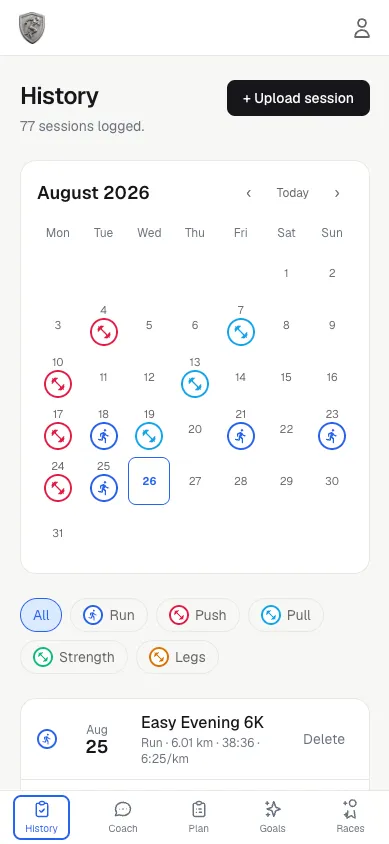
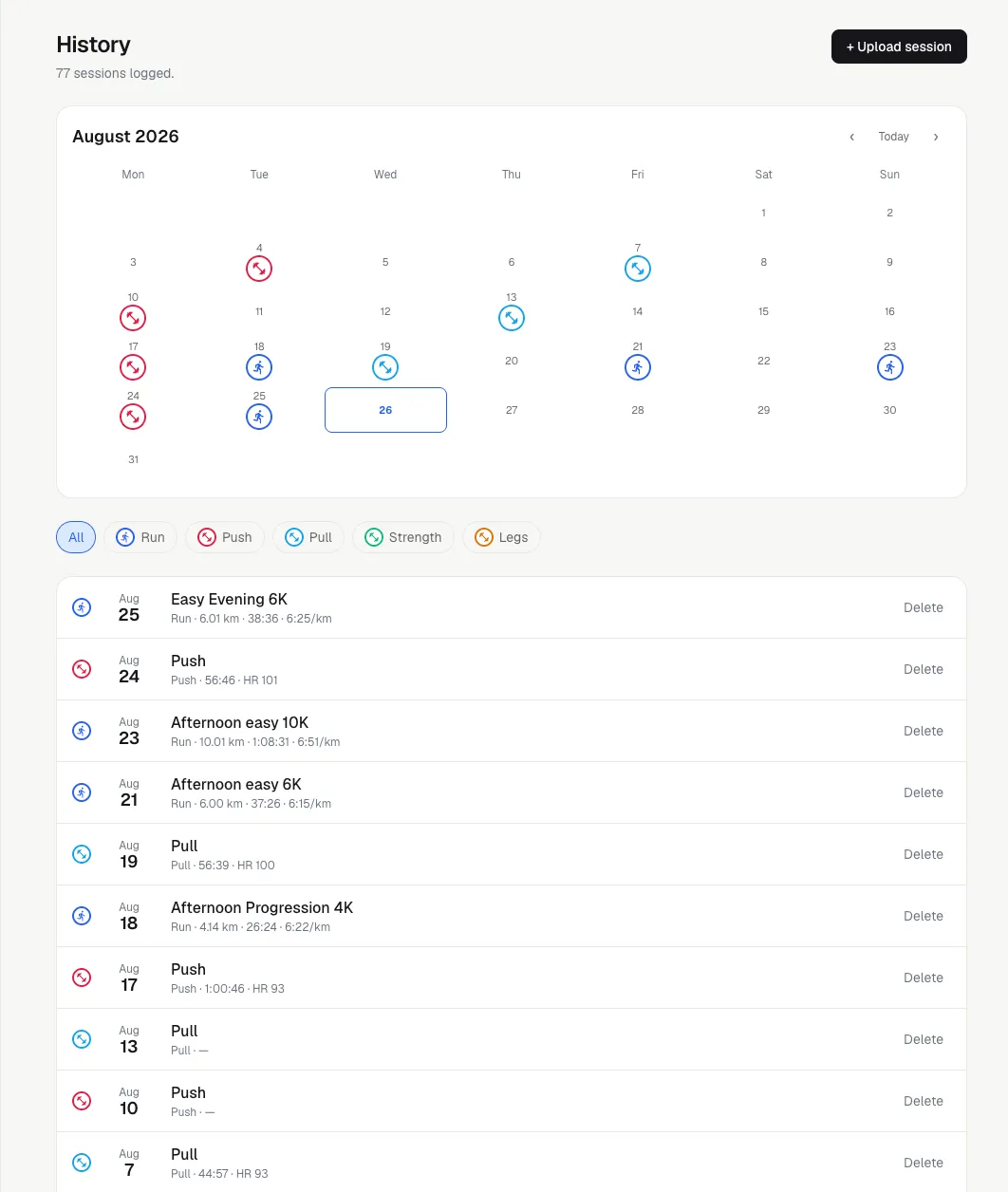
Runs and lifts in one timeline. Which app the session came from stops being something I have to remember.
Metrics that hold up
The parser turns raw samples into per-km splits interpolated at exact 1000 m boundaries, lap and interval breakdowns, elevation with a GPS-jitter deadband, running-form metrics, ACWR training load, personal records and Riegel race projections.
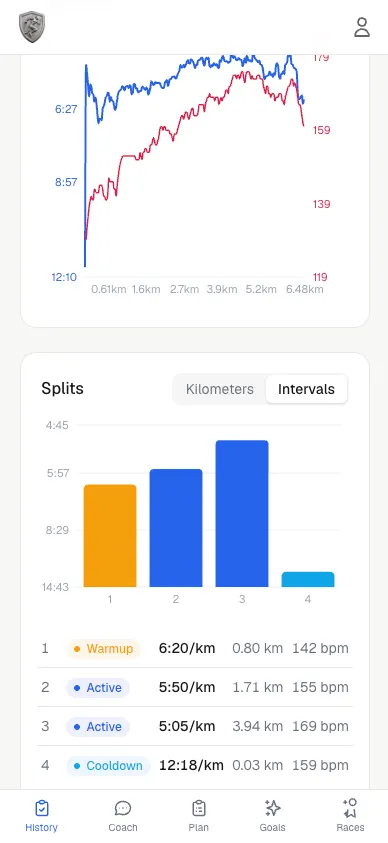
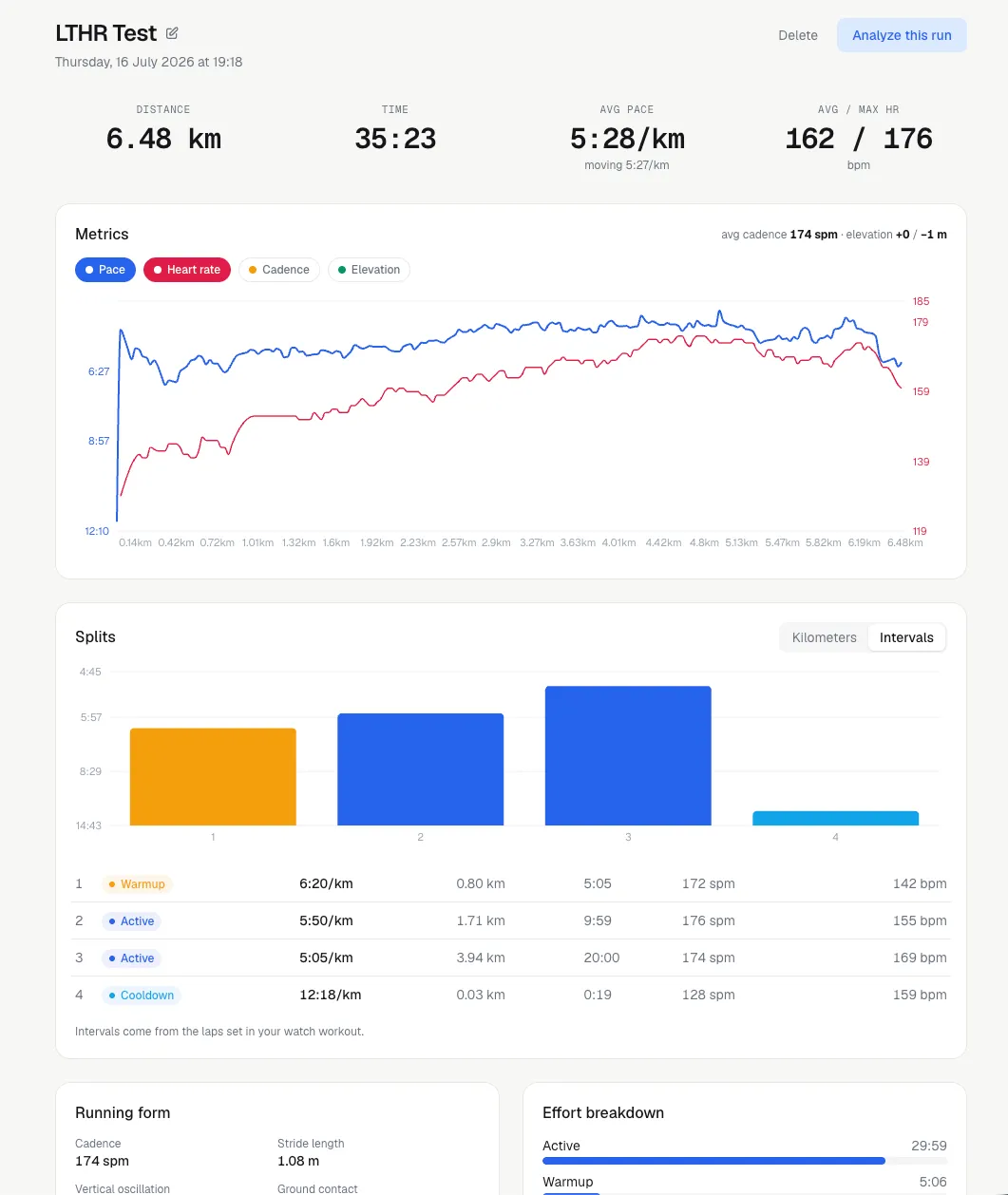
Splits, zone distribution and form metrics on one page. The numbers the coach is reading when it answers.
Two decisions did most of the work:
Zones are re-sliceable
Zone time is computed from a stored per-bpm histogram, not baked in at import. Log a new LTHR test and every run in history re-slices instantly, with no reparse.
Cadence despiking
Apple Watch drops step detection mid-run, poisoning averages and stride length. Each sample is compared against the 65th percentile of its neighbourhood — not the median, because dropouts cluster and drag a median down until it stops flagging them — and only repaired where speed says you were clearly still running. Deliberate walk breaks survive.
The rest of this layer is unglamorous defensive work. European exports are semicolon-separated with decimal commas, inside timestamps too, so everything is parsed positionally and never with a global replace. Backfilling hundreds of days of health metrics row by row blew past the serverless function limit, so the merge happens in memory by date and writes in batches.
A coach that can act
The coach’s context is rebuilt fresh for every message from parallel queries: goals, the macro plan, the current week in full detail, adherence, HR zones, recent runs, gym history, daily health metrics and training load. It doesn’t just talk, it has eleven write tools, so “let’s move the long run to Sunday” actually edits the plan. Responses stream, and each executed tool appears inline as a ✓ receipt.
That matters most on a bad day. When resting HR is climbing, HRV is sagging and the last three nights were short, the coach is told to weigh recovery over the schedule, say so in plain terms, and then rewrite the week — easier Tuesday, long run pushed back, heavy legs off the day before quality work. The advice and the plan change in the same reply, or neither does.
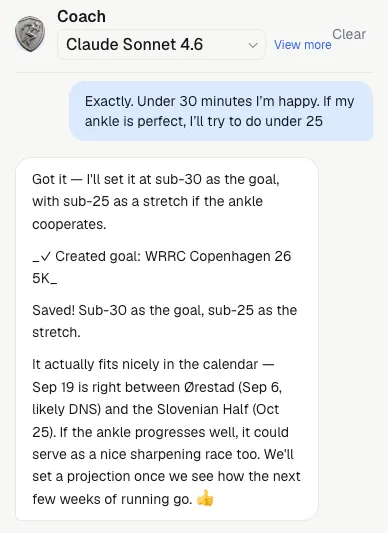
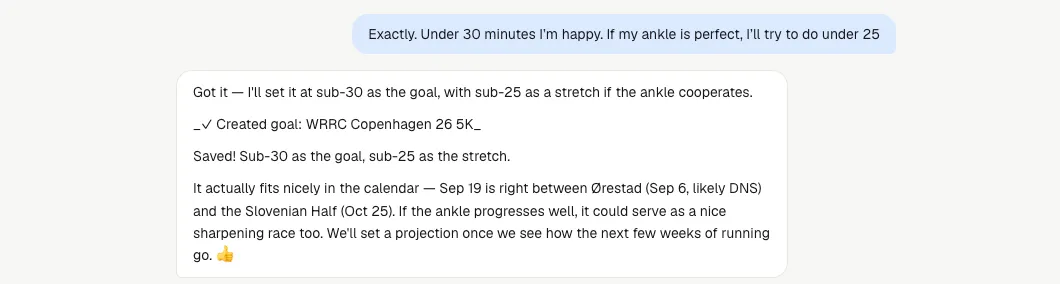
Asking the coach to move a session. The ✓ line is the actual write, if it isn’t there, nothing changed.
Because strength is in the same picture, the week is planned as one thing: runs arranged around lifting rather than on top of it, and each gym day carrying its own prescription, exercise, sets, reps and a target weight progressed from what I actually lifted last time.
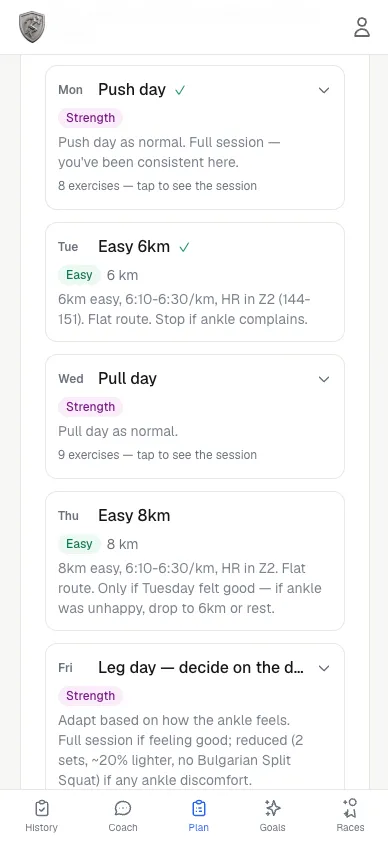
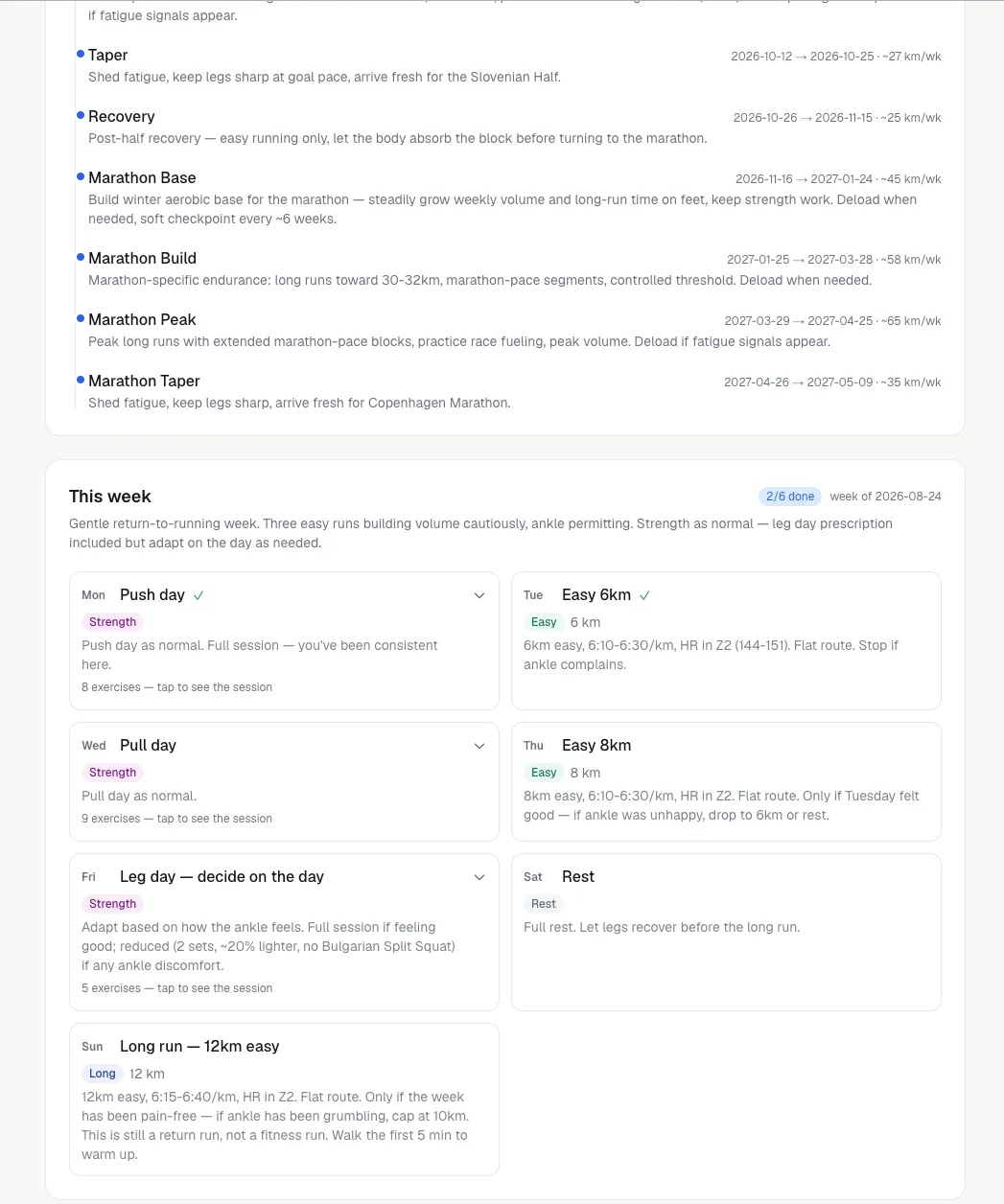
One week, both disciplines. Quality run days land on fresh legs because the plan knows when leg day was.
Models are pluggable: Claude with your own API key, or free OpenAI-compatible open models. That split shaped the architecture, Claude gets the full context with prompt caching, so the static prefix re-reads at roughly a tenth of the cost across the agentic loop, while free models get a deliberately leaner context, shorter history and fewer loop turns so their token quotas last.
Models are benchmarked, not trusted
A harness runs the production system prompt, tools and agentic loop against candidate models on scored scenarios — build a full week, edit one day without regressing the other six, know when not to call a tool — validating every tool call against its JSON schema. Models are promoted or dropped on results. Free providers retire models without warning.
The guardrail that mattered most
A model writing "I've updated your plan" in prose changes nothing. Plans
only change through tool calls, so the system prompt says so explicitly and
the app never trusts narration over state. Open models also emit numbers as
strings, so a schema-aware coercion layer casts "40" back to
40 before execution.
Living with it
The habit change was smaller than I expected and stuck harder. I stopped exporting files by hand, which means I stopped skipping the export and losing sessions. The plan page became the thing I open before the gym instead of deciding what to lift while standing in front of the rack. And because the coach sees sleep and HRV alongside the training, the answer to “should I do the hard session today?” stopped being a coin flip I resolved in favour of ego.
What I got wrong first: I built the coach before the metrics were trustworthy. Early feedback was confident and subtly wrong, because cadence dropouts and mis-sliced zones were feeding it. Fixing the parser improved the coaching more than any prompt change did.
What I learned
Real-world fitness data is adversarial: units change meaning between sources, watches drop sensors mid-run, and every exporter localises differently. The answer that held up was pushing invariants down, dedupe as a database constraint, zones from histograms instead of precomputed buckets, one parser core no matter the ingest path, and measuring model behaviour with a harness instead of trusting it.
The product lesson is narrower and more useful: an AI feature is only as honest as the data underneath it, and only as useful as the actions you let it take.
Where it lands
Gunna turns three disconnected apps into one week a runner can actually train by, where the advice after a hard session accounts for last night’s sleep, and where changing the plan takes one sentence instead of an afternoon.
Next.js (App Router) · React · TypeScript · Tailwind CSS · PostgreSQL (raw SQL) · Anthropic SDK · Garmin FIT SDK · Google Drive & Sheets APIs · Recharts · JWT auth with scrypt hashing and per-user data scoping.